
Introduction:
Illegal mining remains a global challenge, threatening mineral resource security and posing severe risks to geological stability. Traditional “human-centric” prevention—relying on physical patrols—is often inefficient in rugged terrain or vast mining concessions. This paper analyses a modern technological pivot: the implementation of an intelligent microseismic monitoring system in Western Hubei, China. By leveraging the SmartSolo IMU-3C high-sensitivity seismic system, the system transitions from reactive patrolling to proactive, data-driven prevention. This approach treats a mining area as a living acoustic environment, where every unauthorised drill or blast is captured as a distinct “seismic fingerprint.”
Challenge:
The primary technical difficulty in microseismic monitoring is the high “signal-to-noise” ratio common in active or abandoned mining environments. Illegal activities—ranging from manual hand-digging and small-scale hammer strikes to mechanised electric picks and clandestine blasting—generate low-energy seismic waves.
The challenge for the IMU-3C system is two-fold:
- Sensitivity: The hardware must be sensitive enough to detect minute vibrations (microseisms) that are often attenuated by complex subsurface geology.
- Discrimination: The software must differentiate between “cultural noise” (legal traffic, environmental factors) and the rhythmic, high-frequency signatures characteristic of unauthorised extraction tools.
Hardware Architecture & Deployment Strategy:
The backbone of the monitoring network is the SmartSolo IMU-3C, an intelligent three-channel monitoring unit designed for high-fidelity data acquisition. In the Hubei deployment, a 50-node grid was established to ensure comprehensive spatial coverage.
- Advanced Sensing: The system utilises three-component (3C) triaxial geophones. Unlike standard vertical sensors, 3C sensors capture the full wavefield—including primary (P) and shear (S) waves. This multi-axial data is critical for accurately locating the source of a vibration and identifying the specific motion of the mining tool.
- Optimised Installation: To maximise signal clarity, sensors were buried. Subsurface installation significantly reduces “surface noise” from wind or rain, allowing the system to maintain a high level of precision even in poor weather.
- Robust Telemetry: The IMU-3C units provide the versatility required for remote environments. With support for 4G wireless, Ethernet, and a dual power system (mains power with battery backup), the nodes ensure continuous 24/7 data streaming. This redundancy is vital; a loss of power or signal during a “peak” illegal mining window would render the security net ineffective.
Software Intelligence & Signal Processing:
Data without analysis is merely overhead. The integrated software system transforms raw seismic traces into actionable intelligence through several functional modules:
- Real-Time Visualisation & Algorithmic Identification: As data streams from the 50 nodes, the system applies automated algorithms to identify illegal mining patterns. For instance, an electric pick generates a consistent, high-frequency “machine” signature, while manual hammering produces discrete, impulsive signals.
- Automated Alerting via WeChat: Speed is the most critical variable in enforcement. Once a signal exceeds a predefined threshold and is classified as a “potential event,” the system bypasses traditional desktop dashboards and pushes an immediate alert to personnel via WeChat. This ensures that the transition from “event detected” to “officer notified” happens in seconds.
- Spatial Analysis & Mapping: Using satellite GIS integration, the system identifies which specific stations are “triggered.” By analysing the relative arrival times of the signals across multiple nodes, the software can narrow down the location of the activity, providing a coordinate-based target for field teams.
Field Validation:
The deployment in Western Hubei served as a rigorous proof-of-concept. To validate the system, the project team conducted blind “stress tests” using various mining implements within the coverage area.
The results demonstrated a highly efficient end-to-end latency of approximately 2 minutes—measured from the moment a tool struck the rock to the moment a notification arrived on a smartphone. The system successfully captured and classified 100% of the simulated events. Post-event analysis showed that the recorded waveforms, power spectra, and time-frequency patterns matched the on-site physical operations. This high level of correlation provides the “forensic” evidence necessary for regulatory authorities to take legal action.
Technical Value:
The true value of the SmartSolo-based system lies in creating a comprehensive closed-loop mechanism: Monitoring – Early Warning – Response – Feedback.
- Precision Prevention: By utilising “Scientific Defence,” regulators no longer need to search mindlessly. They can identify high-risk “hotspots” and peak activity times, optimising the deployment of limited human resources.
- Geological Hazard Mitigation: Beyond preventing mineral loss, the system serves as a safety net. Early detection of unauthorised tunnelling can prevent secondary disasters such as roof collapses, sinkholes, and ground subsidence that threaten local communities.
Conclusion:
The integration of SmartSolo IMU-3C technology and triaxial sensing provides a robust, scalable solution for mine security. By combining the sensitivity of geophysical instrumentation with the speed of modern mobile communication, the system offers a blueprint for the future of “human and technological” integrated prevention. It is an essential tool for any regulatory body seeking to modernise its oversight and protect the integrity of its mineral assets and the safety of its terrain.
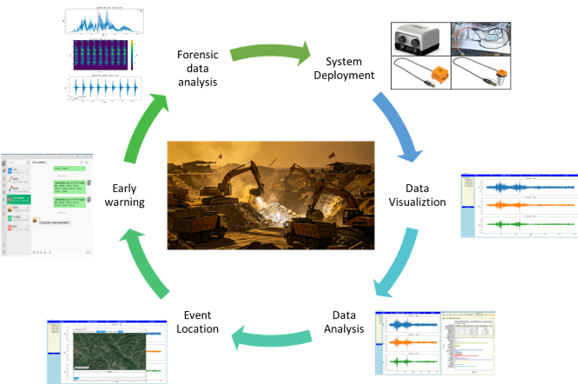
Figure 1. Comprehensive closed-loop mechanism: Monitoring – Early Warning – Response – Feedback, based on the SmartSolo IMU-3C system.