
Overview
Urban environments present unique challenges for near-surface geophysical investigations. Continuous anthropogenic activities—particularly metro operations—introduce strong vibrations into the ambient seismic noise field, which can significantly influence surface wave analysis and subsurface characterisation. This case study summarises a recent peer-reviewed research project conducted near the China University of Geosciences (Beijing), focusing on how metro-induced vibrations affect the extraction of the ambient noise surface wave dispersion curve.
The study was carried out using SmartSolo IGU‑16HR 3C three-component nodal seismometers and provides practical insights for researchers and engineers working in urban seismic monitoring, engineering geophysics, and vibration impact assessment.
Research Background
With the rapid expansion of urban rail transit systems, subway-induced vibrations have become a major source of seismic noise in cities. While ambient noise methods, such as the Spatial Autocorrelation (SPAC) technique, are widely used for shallow subsurface investigations, their reliability can be compromised by strong, time-dependent anthropogenic disturbances.
This research aimed to:
- Quantify metro vibration characteristics in an urban campus environment.
- Evaluate how vibration intensity varies with distance and operational schedules.
- Assess the influence of metro vibrations on ambient noise surface wave dispersion curve extraction.
- Identify time windows and array configurations that yield more reliable dispersion results.
Monitoring Layout and Data Acquisition
Long-term Vibration Monitoring
Four monitoring sites were selected at different distances from the Changping Subway Line, including ground-level and high-rise locations. Continuous three-component seismic data were recorded over five consecutive days, covering weekday and weekend conditions as well as metro peak, off-peak, and non-operational periods.
The SmartSolo IGU‑16HR 3C nodal seismometers were chosen for their autonomous operation, stable three-component recording, and suitability for dense urban deployments where power supply and cabling are limited. Their compact, cable-free design allowed flexible installation across diverse sites, from outdoor ground stations to building floors.
Ambient Noise Array Measurements
To extract surface wave dispersion curves, three SPAC arrays were deployed:
- Two circular configurations with nodes evenly spaced on concentric circles;
- One linear array adapted to space constraints in a built-up area.
These array configurations enabled comparison of dispersion behaviour under different geometric conditions and vibration environments.
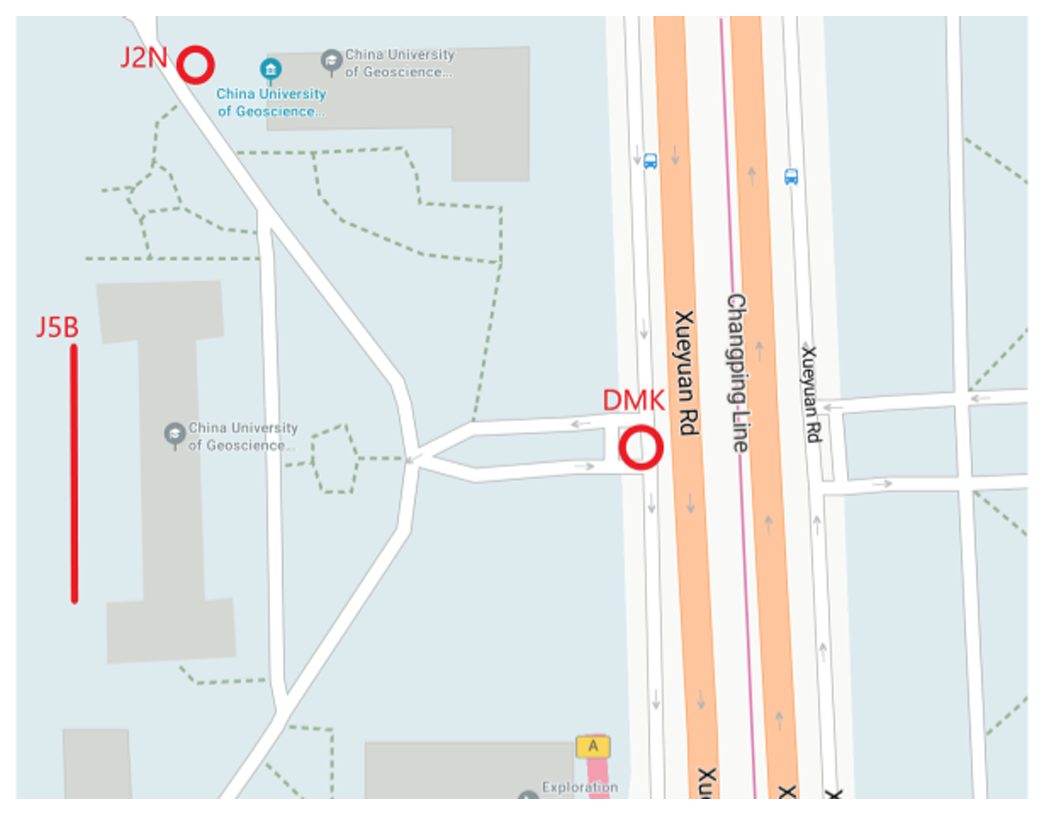
A. Micro-motion SPAC and linear array data acquisition points
Data Processing and Analysis Methods
The study combined time‑domain and frequency‑domain analyses with ambient noise surface wave processing:
- Spectral and energy density analyses were used to identify vibration signatures associated with metro operations.
- SPAC‑based dispersion extraction was applied to ambient noise records, using zero-crossing analysis of spatial autocorrelation functions;
- Signal smoothing, clustering, and spline interpolation were employed to enhance dispersion curve continuity and reduce random noise effects.
By systematically comparing results across locations and time periods, the researchers were able to isolate the specific influence of metro vibrations on dispersion characteristics.
Key Findings
Characteristics of Metro-Induced Vibrations
- Vibration amplitudes increased significantly during metro operating hours, with clear periodic patterns aligned with subway schedules.
- Peak vibration levels corresponded to morning and evening rush hours, while weekends showed overall lower intensity than weekdays.
- Vibration intensity decreased consistently with increasing distance from the subway line, confirming spatial attenuation effects.
Impact on Dispersion Curve Extraction
- Low-frequency dispersion curves (associated with deeper layers) remained relatively stable across different time periods, indicating robustness against surface disturbances.
- High‑frequency dispersion curves (sensitive to shallow layers) showed strong degradation during metro peak hours, including reduced phase velocities and increased scatter.
- Dispersion curve quality was inversely correlated with proximity to the subway: sites closer to the rail line exhibited poorer high-frequency coherence.
- Data recorded during metro off-peak periods provided the most reliable balance between signal strength and scattering conditions for dispersion analysis.
Practical Implications
This study highlights several important considerations for urban seismic and engineering surveys:
- Time‑window selection is critical when using ambient noise methods in metro-affected environments.
- Array geometry and radius should be adapted to both target depth and expected vibration conditions;
- Long-term, continuous monitoring helps distinguish persistent vibration sources from transient noise.
The stable, long-duration recordings from the SmartSolo IGU-16HR 3C sensors were essential for capturing subtle temporal variations and enabling robust comparative analysis across multiple sites and operational scenarios.
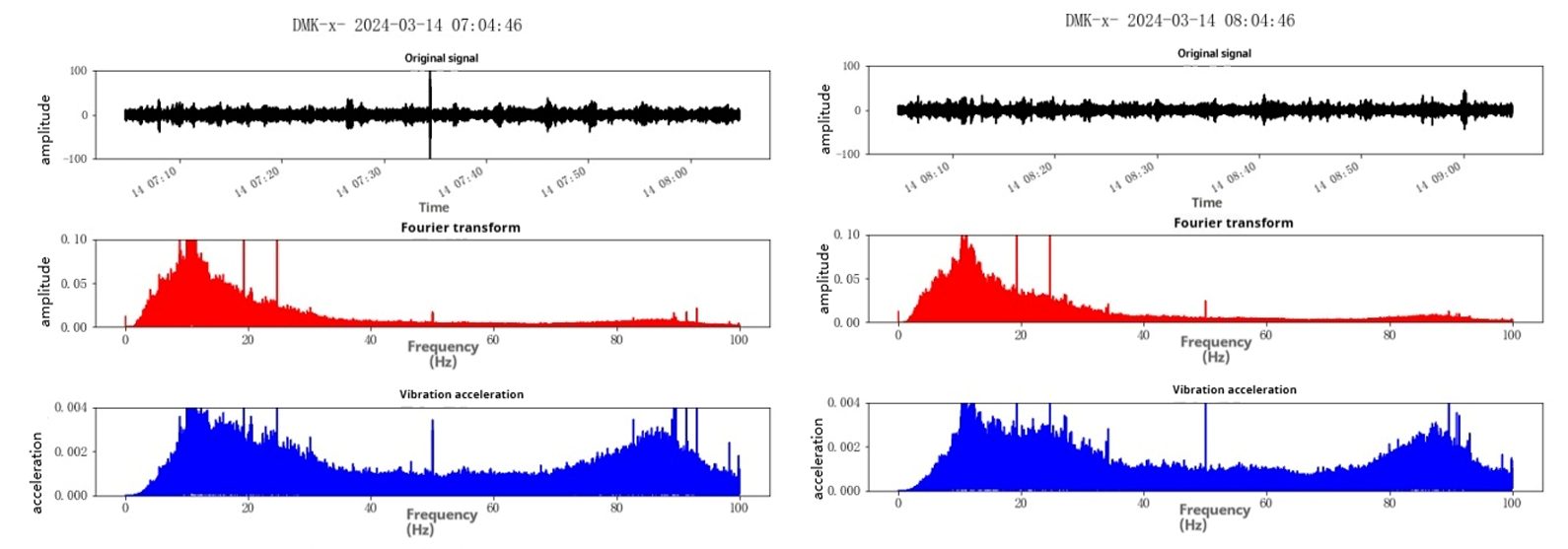
B. Analysis chart of the peak operation end of the Dongmenkou X-component station on March 14th,2024.
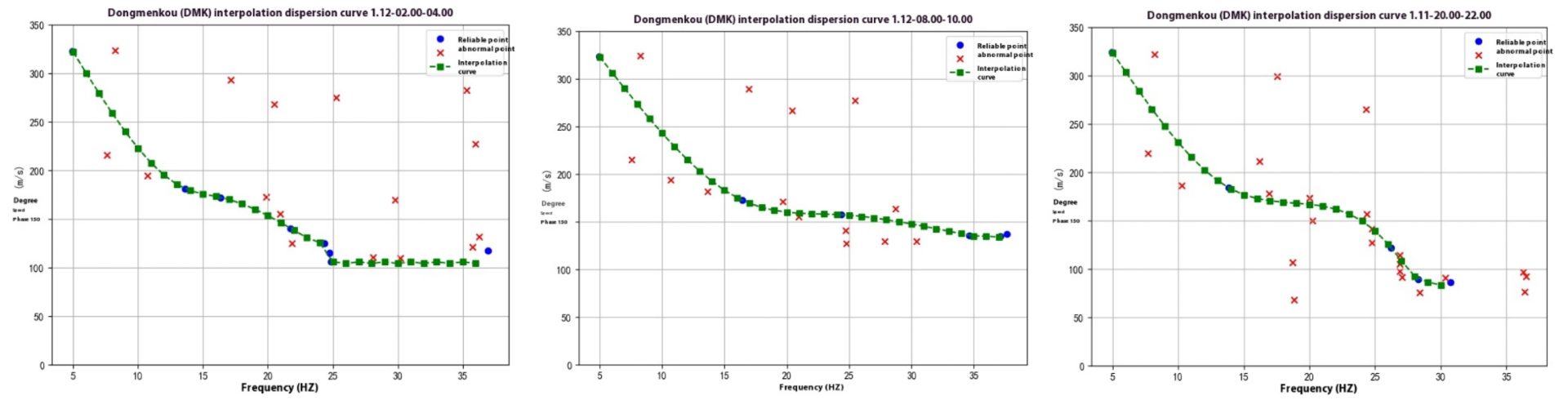
Comparative analysis of different time periods at Dongmenkou
Conclusion
By integrating metro vibration monitoring with ambient-noise surface-wave analysis, this research provides a systematic evaluation of how urban rail transit affects dispersion curve extraction. The findings offer practical guidance for improving data reliability in urban geophysical investigations and underscore the importance of sensor stability, deployment flexibility, and continuous recording capability.
For researchers, geological survey agencies, and engineering investigation companies working in complex urban environments, this case demonstrates how carefully designed monitoring strategies—supported by reliable nodal instrumentation—can mitigate anthropogenic interference and enhance subsurface characterisation outcomes.
Reference: M. Guo, “Research on Metro Vibration Monitoring and Its Impact on the Extraction of Noise Surface Wave Dispersion Curves,” 2025 6th International Conference on Geology, Mapping and Remote Sensing (ICGMRS), Wuhan, China, 2025, pp. 412-415, doi: 10.1109/ICGMRS66001.2025.11065570.